The American diner did not start as a restaurant at all. It started as a wagon, parked on a street corner at night, selling food to people who had nowhere else to eat once everything around them had closed.
The lunch wagon era
Walter Scott is usually credited with the first version of the idea, running a horse-drawn food wagon through the streets of Providence, Rhode Island, from 1872 onward, serving sandwiches, pies and coffee to night shift workers and anyone else out after the restaurants had shut. Other operators across the American Northeast followed quickly, and by the 1880s these wagons had grown more elaborate: larger wheels, painted murals, frosted glass windows, a small stove and an ice box inside, and eventually, in at least one documented case from 1887, seating built directly into the wagon itself rather than service through a side window. The food was simple and the hours were long, but the format solved a real gap: almost nothing else was open late at night or early in the morning.
From wheels to a fixed address
Lunch wagons gradually gave up their wheels. Manufacturers like Thomas Buckley's Worcester Lunch Car Company, based in Worcester, Massachusetts, began building larger, heavier cars meant to be towed into place once and left there, with smaller wheels, proper counters, tiled interiors and eventually bathrooms, turning a mobile food cart into something closer to a permanent restaurant. Sources differ on exactly when the first fully stationary diner appeared, with some pointing to the early 1910s, but the direction of travel is clear either way: operators kept the compact, counter-service shape of the old lunch wagon while trading the wheels for a fixed foundation.
Streamlining and the rise of chrome
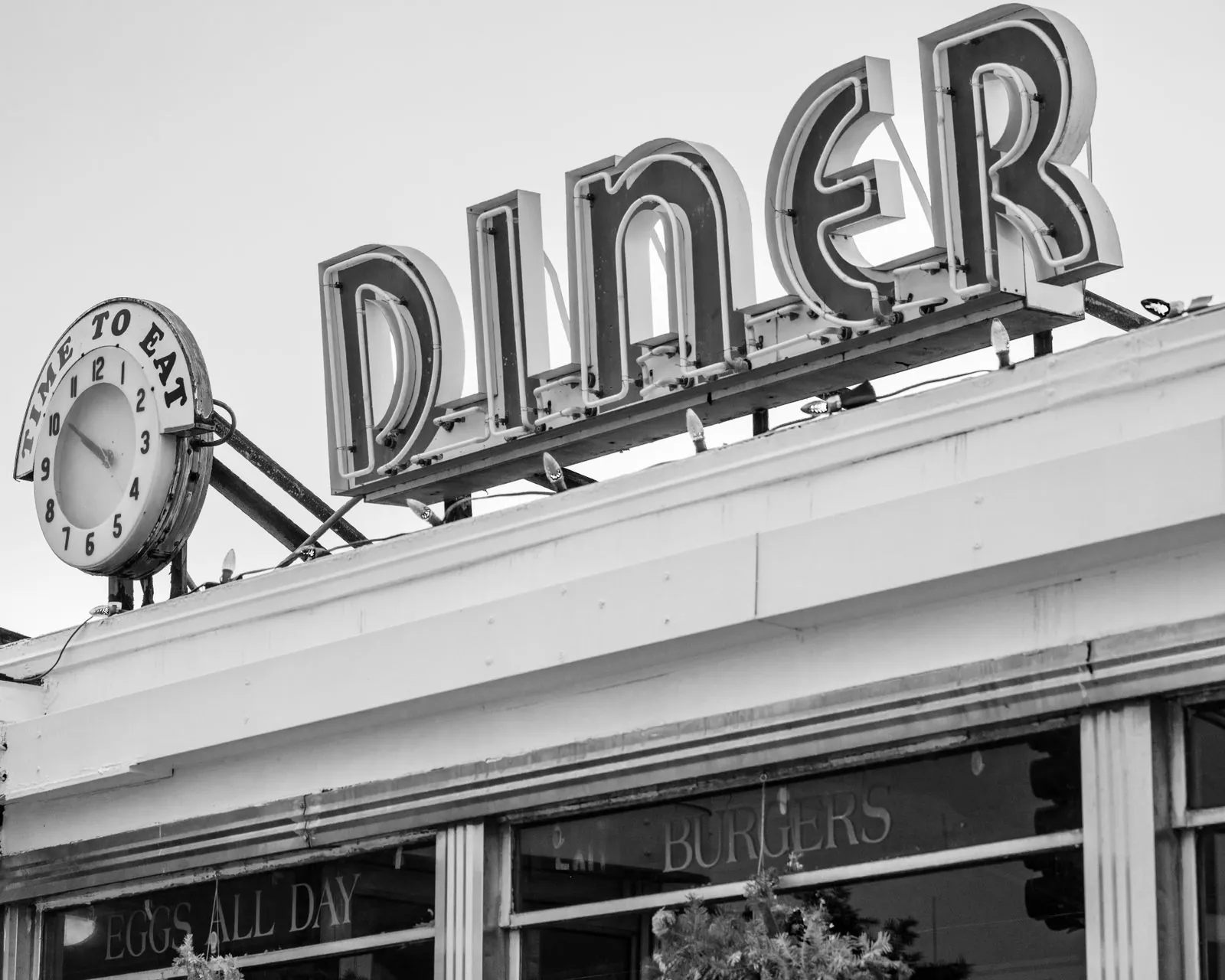
The diner picked up its most recognisable look in the 1930s, borrowing the streamlined, bullet-shaped design language that was showing up everywhere from trains to cars at the time. Earlier diner cars had mostly been built from wood, but manufacturers increasingly turned to stainless steel and chrome trim, both because it looked modern and because it was easy to keep clean behind a busy counter. Neon signage spread alongside the new materials, and by the 1940s the diner had settled into the silhouette most people still picture today: a long, narrow, metal-clad building with a row of stools along a counter and a line of booths against the windows.
The 1950s heyday
The decade most associated with the American diner is really its commercial peak rather than its origin. Prefabricated diners, built in factories and shipped out whole by truck or rail, let operators open quickly almost anywhere with road traffic, and companies like the Worcester Lunch Car Company, which operated from 1906 until 1957, turned out hundreds of these cars during that run. Jukeboxes, tabletop mini-jukeboxes at individual booths, and a menu built around burgers, hot dogs, milkshakes and pie became the standard package, less because any single diner invented the formula and more because the format had, by this point, been refined for nearly eighty years already.
Why the look still works
Diners that still use this design today are not simply copying a style for nostalgia's sake. The long counter, the booths, the open kitchen within sight of the room, all of it comes from decades of figuring out how to serve food quickly to people coming and going at every hour, which is exactly the problem the format was built to solve in the first place back on Walter Scott's wagon in 1872. For the building this particular guide is anchored around, the history of the site behind this one picks up a much later, local chapter of that same story, and the cultural half of it, how diners ended up on screen and on record, continues on the diners in pop culture page.